2008/01/19
OpenID and OAuth at WebGuild's Web 2.0 Conference
On Jan 29 I'll be on an OpenID & OAuth panel at the WebGuild Web 2.0 Conference and Expo in Santa Clara, CA. Shreyas Doshi of Yahoo will be there, which will be a great opportunity to discuss where OpenID is headed. (My former compatriot George Fletcher will be there as well, along with Nico Popp of Verisign, and Johannes Ernst will be moderating.)


2008/01/18
Blogger now an OpenID Provider

Yesterday, in addition to launching Blogger in three new languages, we pushed out a draft feature: Your blog is your OpenID. Technically, this means that Blogger is both an OP and an RP; we've accepted OpenID signed comments since December.
We've implemented OpenID 1.1 so far, so we should be compatible with all OpenID 1.1 RPs. Please test it out (see instructions for opting in) and let us know if you see problems.
It's also great to see Yahoo announcing that they'll be an OpenID 2.0 Provider. I hope they implement RP support soon too, at least for things like Flickr comments.
2008/01/16
Time to Toss RDBMSes?
The End of an Architectural Era (It's Time for a Complete Rewrite) is a good read. I've certainly gotten immensely frustrated with the inability of RDBMses to actually cache or partition intelligently (memcached is great, but also an indictment of an infrastructure that can't keep up). (Via Joe Gregorio.)
2008/01/15
Going to Social Graph Foo Camp 08
This should be fun. I hope I'll have something interesting to say at Social Graph Foo Camp. I know I'll hear a lot of interesting discussions. Any tips?
(Hmm. Are we really going to camp outside in February in Sebastopol? It's doable I guess but...)
(Hmm. Are we really going to camp outside in February in Sebastopol? It's doable I guess but...)
2008/01/12
Episode V: The Writers Strike Back
Striking writers, with plenty of time on their hands, are starting their own companies Silicon Valley-style to bypass old guard distribution networks. It'll be interesting to see how ventures such as Virtual Artists and others (Striking writers to launch online video co.) play out. Most amusingly, since the producers' position is that online media is an "unproven and untested market", they're going to have to publicly pretend that these ventures don't scare the living crap out of them.
2008/01/11
Moving on to abstractioneer.org
I've decided to take the plunge and move on to publishing at http://abstractioneer.org, powered by Blogger. Since I'm the tech manager for Blogger it seems only fitting, and we've recently been adding a whole host of cool features that make it more and more attractive (OpenID commenting being just the latest).
I also have a semi-new Feedburner blog feed; some people were already subscribed through this feed, so you may notice no disruption in service as I re-point it at abstractioneer.org... just a moment... there! (http://feeds.feedburner.com/aol/SzHO). Feel free to re-subscribe there, if you are in the mood.
I also have a semi-new Feedburner blog feed; some people were already subscribed through this feed, so you may notice no disruption in service as I re-point it at abstractioneer.org... just a moment... there! (http://feeds.feedburner.com/aol/SzHO). Feel free to re-subscribe there, if you are in the mood.
Warumungu Norms, Privacy, Facebook, and Useful Friction
We could learn something from the Warumungu. Wendy Seltzer's Mukurtu Digital Archiving: digital "restrictions" done right is about DRM, freedom, and controls; I think it's also about privacy. What's private, and what's public, and what's semi-private are culturally determined no less than the Warumungu rules around who is allowed to see what artifacts:
Who owns the data?
L'Affaire Scoble raised the question, who owns relationship data? Dare Obasanjo argues that his contact data is his, not Robert's. And he wants Facebook to enforce this.
I'd argue that we should un-ask the ownership question. As long as we're talking about ownership, we're heading down the road towards DRM that has worked out so well for the music business. I'd like to talk about community norms, and what kind of useful friction we should be thinking about in the pure digital realm to give community norms a chance to operate. Reputation and portable identity is part of this, as are things like limited access (E.g., OAuth), rate limits, soft constraints, and user centric norm enforcement. (What would happen if the people on Robert's friends list were simply informed, in real time, that he was copying their data for an unknown purpose?)
(Nick Carr has a great post on this subject as well.)
...the Warumungu have a set of protocols around objects and representations of people that restrict access to physical objects and photographs. Only elders may see or authorize viewing of sacred objects; other objects may be restricted by family or gender. Images of the deceased shouldn’t be viewed, and photographs are often physically effaced. When the Warumungu archive objects or images, they want to implement the same sort of restrictions.With an interesting twist:
People can also print images or burn CDs and thus allow the images to circulate more widely to others who live on outstations or in other areas. In fact, one of the top priorities in Mukurtu’s development was that it needed to allow people to take things with them, printing and burning were necessary to ensure circulation of the materials.What, then, prevents people from violating these norms?
Because the Murkurtu protocol-restrictions support community norms, rather than oppose them, the system can trust its users to take objects with them. If a member of the community chooses to show a picture to someone the machine would not have, his or her interpretation prevails — the machine doesn’t presume to capture or trump the nuance of the social protocol.People, relationships, and norms are fuzzy and messy, so maybe it's reasonable that a system to deal with them is fuzzy and messy too. What Murkurtu does is put enough useful friction in the way of disclosure to give community norms a chance to operate. You can't email an image out to a mailing list, but you can print it and show it to a reasonably small number of people at a time. The point is not to control distribution perfectly, but to give human-scale trust mechanisms a chance to operate correctly.
Who owns the data?
L'Affaire Scoble raised the question, who owns relationship data? Dare Obasanjo argues that his contact data is his, not Robert's. And he wants Facebook to enforce this.
I'd argue that we should un-ask the ownership question. As long as we're talking about ownership, we're heading down the road towards DRM that has worked out so well for the music business. I'd like to talk about community norms, and what kind of useful friction we should be thinking about in the pure digital realm to give community norms a chance to operate. Reputation and portable identity is part of this, as are things like limited access (E.g., OAuth), rate limits, soft constraints, and user centric norm enforcement. (What would happen if the people on Robert's friends list were simply informed, in real time, that he was copying their data for an unknown purpose?)
(Nick Carr has a great post on this subject as well.)
Subscribe to:
Posts (Atom)
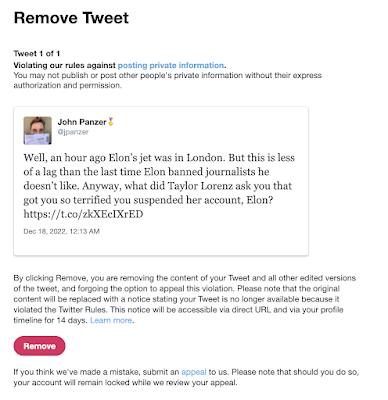
Suspended by the Baby Boss at Twitter
Well! I'm now suspended from Twitter for stating that Elon's jet was in London recently. (It was flying in the air to Qatar at the...
-
 Update 6/2/2023: I was right . These are my observations for our local conditions (Santa Clara County, July 10-12, 2020), which to summarize...
 -
 Last night Rachel Maddow talked about an apparently fake NSA document "leaked" to her organization. There's a lot of info t...
 -
Well! I'm now suspended from Twitter for stating that Elon's jet was in London recently. (It was flying in the air to Qatar at the...
