Ugh. Over the weekend, the DNS provider for abstractioneer.org helpfully upgraded their software... and the new code refused to let me make abstractioneer.org be a CNAME for ghs.google.com, claiming it's illegal. (No, it's not, it just keeps you from using mail to that domain and a couple of other things, none of which I care about.)
All of which means that (a) abstractioneer.org is now www.abstractioneer.org; (b) my OpenID has now changed, with the old one (abstractioneer.org) doing a 302 redirect to the new one (www.abstractioneer.org). I'm viewing this as an experiment; let's see what breaks.
2008/02/04


2008/02/01
The Unbearable Lightness of the Social Graph API
Cool. Looks like we've announced Brad's Social Graph API! Looking forward to talking with people at Social Graph Foo Camp about this. One note... one of the pieces of public data which the API leverages is OpenID delegate links. So a user can prove ownership of an entire set of appropriately-linked Social Graph nodes.
The best place to play with the API (and see what data it's returning) is with the Playground tool.
The best place to play with the API (and see what data it's returning) is with the Playground tool.
2008/01/30
OpenSocial 0.7 and makeRequest
We're converging towards 1.0! There's one particular thing I want to quickly highlight: makeRequest. This goes beyond the old IG_Fetch API to allow arbitrary HTTP requests to arbitrary URLs, with full use of headers, POST data, response codes, etc. This effectively means that properly installed gadgets can talk any protocol to any server on the Internet. Now that's open.
There are controls of course. The container validates that the request is coming from a properly installed gadget, and poorly behaving gadgets can be rate limited or shut off if necessary.
You can also pass certain headers which are awfully useful. For example...
(This assumes of course that the gadget can securely store a token for later use. Gadgets can store data securely using the OpenSocial APIs, but since the user at the browser ultimately has full control over the client side environment, this is effectively the same as a client without a very secure secret. A server side signing solution is needed if you want to to beyond more than simple scenarios involving a user looking at their own data. We're already using OAuth with an empty token to let gadgets talk to their home servers securely, so adding this won't be difficult.)
There are controls of course. The container validates that the request is coming from a properly installed gadget, and poorly behaving gadgets can be rate limited or shut off if necessary.
You can also pass certain headers which are awfully useful. For example...
Which would let you do authenticated cross-domain requests.Authorization: OAuth realm="http://sp.example.com/",
oauth_consumer_key="0685bd9184jfhq22",
oauth_token="ad180jjd733klru7",
oauth_signature_method="HMAC-SHA1",
oauth_signature="wOJIO9A2W5mFwDgiDvZbTSMK%2FPY%3D",
oauth_timestamp="137131200",
oauth_nonce="4572616e48616d6d65724c61686176",
oauth_version="1.0"
(This assumes of course that the gadget can securely store a token for later use. Gadgets can store data securely using the OpenSocial APIs, but since the user at the browser ultimately has full control over the client side environment, this is effectively the same as a client without a very secure secret. A server side signing solution is needed if you want to to beyond more than simple scenarios involving a user looking at their own data. We're already using OAuth with an empty token to let gadgets talk to their home servers securely, so adding this won't be difficult.)
OpenID and Friends
Johannes retconned a nice title onto our panel discussion yesterday: OpenID and Friends (where the friends include OAuth, OpenAuth, OpenSocial, etc.) The panel in fact might have been a little too friendly -- maybe we needed somebody (Ben?) debating with us about phishing attacks to shake things up a bit. It was great to talk with Shreyas, Johannes, Nicolas, and George about issues and next steps. We all have a variety of goals, all of which are advanced by OpenID adoption and use.
2008/01/26
It's an Honor Just to be Nominated
Cool: Blogger has been nominated for the "Best Web Application for Weblogs" category in the 2008 Bloggies. Parenthetically, PostSecret has already run away with the "Blog Nominated in the Most Categories" category, which is great because (a) it's awesome and (b) it's on BlogSpot, so if it wins we all bask in reflected glory. Or something.
Microsoft, DataPortability.org, Chalk, and Cheese
It's great to hear that Microsoft is joining DataPortability.org. I think this group has potential; if nothing else, it's a useful forum for interested parties such as Google, Microsoft, and Facebook to openly discuss policies that will benefit all of our users.
I was a bit disturbed to find some spin in Dare Obasanjo's commentary, though. He says:
The chalk: OpenSocial is comprised of a bunch of companies and individuals all working together on a common set of standards for social networking. There is an open source reference implementation hosted by the Apache Foundation in which anyone can participate. (Dare, if you're not feeling invited, please contact me directly!)
The cheese: Microsoft is sending cease and desist letters to startups who are importing contacts from Hotmail, which are then used as leverage in back room deals to try to get the startups to use Microsoft's Messenger IM service to the exclusion of competing services.
Let's skip that though and talk about open and unencumbered protocols. Dare, I agree with you that we need these. I think that things like OpenID and OAuth are building blocks towards this, and I hope that we can discuss some of the hard issues at Social Graph Foo Camp. In the front room, of course!
I was a bit disturbed to find some spin in Dare Obasanjo's commentary, though. He says:
... The fact that when interoperability happens, it is in back room deals (e.g. Google OpenSocial, Microsoft’s conversations with startups, etc) instead of being open to all using standard and unencumbered protocols is similarly troubling.Whoa, let's deconstruct. This associates OpenSocial and Microsoft's "strong-arm" tactics by putting them in the same list, trailed by 'etc' to imply that these are just a couple of typical examples. Slap parentheses around it, and label the whole list "back room deals". Maybe no one will notice that you've just conflated chalk and cheese:
The chalk: OpenSocial is comprised of a bunch of companies and individuals all working together on a common set of standards for social networking. There is an open source reference implementation hosted by the Apache Foundation in which anyone can participate. (Dare, if you're not feeling invited, please contact me directly!)
The cheese: Microsoft is sending cease and desist letters to startups who are importing contacts from Hotmail, which are then used as leverage in back room deals to try to get the startups to use Microsoft's Messenger IM service to the exclusion of competing services.
Let's skip that though and talk about open and unencumbered protocols. Dare, I agree with you that we need these. I think that things like OpenID and OAuth are building blocks towards this, and I hope that we can discuss some of the hard issues at Social Graph Foo Camp. In the front room, of course!
2008/01/24
Identity Conflation = Profit!
True story: I was just contacted by a company looking to pay an outstanding invoice to "John Panzer" for consulting work; they had lost the original contact information and found me on the Internet. I hope the John Panzer doing consulting in New York gets paid properly; it sounded like pretty good money!
Subscribe to:
Posts (Atom)
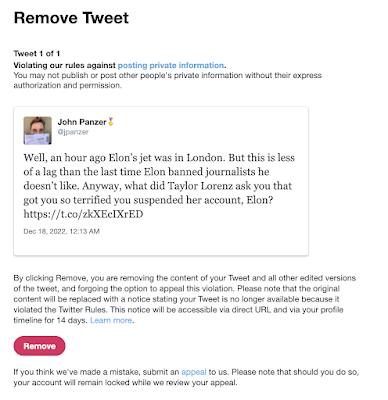
Suspended by the Baby Boss at Twitter
Well! I'm now suspended from Twitter for stating that Elon's jet was in London recently. (It was flying in the air to Qatar at the...
-
 Update 6/2/2023: I was right . These are my observations for our local conditions (Santa Clara County, July 10-12, 2020), which to summarize...
 -
 Last night Rachel Maddow talked about an apparently fake NSA document "leaked" to her organization. There's a lot of info t...
 -
Well! I'm now suspended from Twitter for stating that Elon's jet was in London recently. (It was flying in the air to Qatar at the...
