Earlier this week, we announced support for Gadgets inside Blogger. I've been a bit too busy to blog about it, but it's worth a special mention. There's a gadget directory, which pulls content from iGoogle's directory. OpenSocial gadgets can work as well, if you make the social APIs optional (Optional feature="opensocial-0.8"); other than that, the JS API is the same as for Orkut and OpenSocial containers. Will Blogger get social? Wait and see...
2008/08/15


2008/07/24
RESTful batching w/JSON

I've proposed an alternative RESTful batching format to the OpenSocial spec list. It's conceptually the same as the multipart proposal, but hopefully much easier for web servers and clients to deal with (JSON only for now).
Open Web Foundation is born!
Announced at OSCON this morning. Sweet! (Hopefully this is the Last Foundation...)


2008/07/11
Heading to Foo Camp
...up in Sebastopol. May actually camp this time. There are so many Google people going, I looked into whether we could charter a bus, just like summer camp. No dice; maybe next year people will see a bunch of Googlers singing songs in a bus.
2008/07/06
How to Change the World: The Growth Mindset
How to Change the World: The Growth Mindset: Guy Kawasaki points to an article about Carol Dweck's work on growth vs. fixed mindsets, which is a great prod to me.
I went to a talk recently by Carol about how children's attitudes towards performance and learning greatly affects their performance, with some good statistical data on studies she and others have done. The take-away, for children: It's more more effective to believe that you can and should grow your abilities vs. believing that abilities are inherent. Don't tell your childen they're smart (fixed mindset), tell them it's great that they're trying hard and can improve (growth mindset).
The problem with the fixed mindset is that it leads to fear - if you can't do something right, then clearly you can't do it, and you'd better hide that fact as quickly as possible, mostly by not trying. The growth mindset, on the other hand, assumes that you can always improve. The latter, unsurprisingly, leads to better performance -- and to learning how to learn and improve.
The same mindsets appear in adults as well of course. Since software engineering is effectively a learning exercise, the growth mindset is much more effective than the fixed mindset.
I went to a talk recently by Carol about how children's attitudes towards performance and learning greatly affects their performance, with some good statistical data on studies she and others have done. The take-away, for children: It's more more effective to believe that you can and should grow your abilities vs. believing that abilities are inherent. Don't tell your childen they're smart (fixed mindset), tell them it's great that they're trying hard and can improve (growth mindset).
The problem with the fixed mindset is that it leads to fear - if you can't do something right, then clearly you can't do it, and you'd better hide that fact as quickly as possible, mostly by not trying. The growth mindset, on the other hand, assumes that you can always improve. The latter, unsurprisingly, leads to better performance -- and to learning how to learn and improve.
The same mindsets appear in adults as well of course. Since software engineering is effectively a learning exercise, the growth mindset is much more effective than the fixed mindset.
Subscribe to:
Posts (Atom)
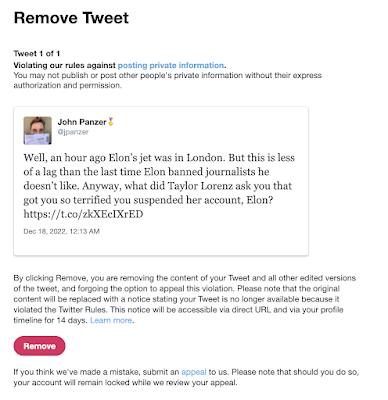
Suspended by the Baby Boss at Twitter
Well! I'm now suspended from Twitter for stating that Elon's jet was in London recently. (It was flying in the air to Qatar at the...
-
 Update 6/2/2023: I was right . These are my observations for our local conditions (Santa Clara County, July 10-12, 2020), which to summarize...
 -
 Last night Rachel Maddow talked about an apparently fake NSA document "leaked" to her organization. There's a lot of info t...
 -
Well! I'm now suspended from Twitter for stating that Elon's jet was in London recently. (It was flying in the air to Qatar at the...
