2007/02/10

Jangl, community, Internets

I'm hanging out at the Community Next conference at Stanford this afternoon.  A couple of quick takes:

Jangl provides control over who can call you; put a widget on your web page and people can call you but not get your real phone number.  And Jangl lets you control who actually gets through.  Really a feature that the cell phone companies should provide but don't -- so if Jangl is successful, will the telecoms just copy it?

Also, from skinnyCorp:
Image from AOL Pictures

(Don't you just ask people to roll coins through the tubes?)

Tags: , ,

2007/02/07

OpenID + CardSpace = Ubiquity

It's great to see Bill  Gates announce that CardSpace will integrate with OpenID.  Convergence, and momentum, is building.

It's also great to see people like Kevin blogging about OpenID and AOL (OpenID: Should AOL Care?) (Yes.)

2007/02/05

The Essential Hardness of Programming

Software engineering's preoccupation is the arrangement of bits, as opposed to atoms. One of the properties of bit arrangements is that their marginalmanufacturing cost is zero; once you have an arrangement of bits, youcan make as many exact copies of that arrangement as necessary,whenever and wherever they're needed.  By contrast, an arrangement ofatoms such as a bridge has a large marginal manufacturing cost, even ifyou just want an exact copy.  Further, there are few physical limits tobits, while there are sharp physical limits to atoms.  The only reallimit to bit arrangement is the human brain, and economics (how badlypeople want bits arranged in particular ways). 

These are the fundamental reasons why nearly every software engineering project is attempting new design, and is thus hard. This is because, in the world of software, design equals bitarrangements and copying a prior bit arrangement has zero cost. Finding an appropriate bit arrangement used to have substantial cost,but that cost is falling towards zero too.  So for a given project, youcan assume that competent software engineers have mostly found andcopied the relevant patterns of bits where possible, and the remainingwork is design. 

Think about what the statement above means.  This isn't like a civilengineer dealing with slightly differing terrain or traffic loads whenadapting an existing design for a new bridge; it's more like a civilengineer being asked to build a bridge out of Jello on Pluto.  And thenext time, to build atop a moving lava flow on Mercury.  In otherwords, with the easy, mechanical adaptations being taken care of bythose ubiquitous bit patterns, the problems that are left for people towork out are the hard, surprising, novel ones.  Usually with nonlinearAnd in software, design really is everything; once you've taken designto a detailed enough level that the implementation is mechanical... welet the machines do it.

Which is why I winced when I read Scott Rosenberg's interview in Salon. He gets it exactly right when he notes that there's always somethingnew in every software project, otherwise there'd be no point in doingit.  But he goes off the rails when he says, "...programmers areprogrammers because they like to code -- given a choicebetween learning someone else's code and just sitting down and writingtheir own, they will always do the latter."  Jonathan Rentzsch hasalready skeweredthis statement better than I could.  It is of course true that thereare some people who just aren't good at finding prior solutions, or atunderstanding them once found, and they may contribute to unnecessaryre-creation of software, increasing both cost and risk to largerprojects.  But they're not the norm, and aren't a major cause of the"always something new" phenomenon.  The essence of software developmentis new design.

This is also why attempts to map manufacturing based activities tosoftware development are at best rough approximations and at worstdangerous distractions.  Software development is a knowledgeacquisition activity, not a manufacturing activity.

2007/01/18

Buddy Stalker

Kevin Lawver demoed a cool Buddy Stalker mashup yesterday at Mashup Camp 3 that combines AOL's feeds infrastructure, AIM , and Open Authentication to let you stalk your buddies online.  All of it tied together with Rails in about 8 hours (and the last 2 hours were probably just tweaking the CSS).

Personally, I want one more level of abstraction on top of this.  Something like a personal buddy zeitgeist tag cloud, updated dynamically, showing what my buddies are up to.

2007/01/16

application/atom+json? and more on our converter

Sam Ruby's recent post (Application/Atom+JSON) has sparked some interesting comments.  Is there value in a standard way to represent Atom data in JSON data structures?  I think so.  I do think that we need to have a way for transparent pass-through of generic elements (which means some scheme for dealing with Atom extensions, which means dealing with at least some subset of XML namespaces).

In other news, we're  working on fixing the issues that Sam noted in AOL's Atom-to-JSON converter.  The good news is that most of these issues have to do with the underlying ROME library we're using, and so the fixes that Joseph van Valen is making will be contributed back to the community. 

It turns out that the same issues are present even if you specify Atom as the output format; while Atom-to-Atom isn't a very useful converter, it's awfully useful as a test case.  For example, the Feed Validator tells us that something is munging hreflang.  It's also dropping rel="self" and other links for some reason... all of these things look like simple bugs, easily fixed.  The converter actually does seem to pass through elements it doesn't understand for entries, but not for feeds, which looks like a simple oversight.

2007/01/14

Yes, Steve, I do want my phone to be an open platform

I was captivated by the iPhone announcement.  It's a great looking design; I suspect that Apple, being Apple, has probably nailed the actual interaction too, including keyboard.  I was ready to buy one immediately (darn that pesky FCC!).  But then:

"You don't want your phone to be an open platform," says Steve Jobs. 

What?  Yes, I do.  I want to carrry just one personal device that serves me the way I want.  I do not want to be locked in to a "garden of pure ideology" (warning: ironic link) defined by any one company.  I want a free market.

And: "Cingular doesn't want to see their West Coast network go down because some application messed up."

That's simply laughable.  If Cingular's network is so fragile that a single poorly coded application can destroy it, they have much bigger problems than needing to lock down the iPhone.  You deal with those issues at the protocol and network levels, not at the clients.

I won't even try to predict whether this is a fatal flaw for the iPhone -- it has a lot of other things going for it, and of course it is a decision which can easily be changed.  But it will determine whether the iPhone is a game-changer or just a cool looking phone.

Doc Searls' take: "Well, it's good either way. Because a closed iPhone is a market opening for Nokia, Motorola and the rest of them."

Yup.

2007/01/11

Generic Atom-to-JSON Conversion

Yesterday, our feeds infrastructure team released a bunch of new code.  There's actually a lot that this service can do; one of the cooler things it now does is to convert arbitrary Atom or RSS feeds into cross-domain-retrievable JSON data structures:

curl -v 'http://headlines.favorites.aol.com/hlserver/api/GetFeed.do?
url=http://journals.aol.com/panzerjohn/abstractioneer/atom.xml&format=atom-json&callback=cb'

which returns, in part, the data structure below.  The big win is the ability for any web page to retrieve feed data from any feed source without needing to set up a custom proxy.  Obviously, there's still a proxy involved here, and it's one we're running; it does both feed format normalization and caching and is highly scalable.  I hope we can turn this into a supported, documented API on dev.aol.com soon.

The output looks like this:

cb(
{
"feed" :  
  {
  "aj:accessType":
      {"xmlns:aj":"http://journals.aol.com/_atom/aj#","content":"public"},
  "xmlns:sy" : "http://purl.org/rss/1.0/modules/syndication/",
  "aj:blogShortName":
      {"xmlns:aj":"http://journals.aol.com/_atom/aj#","content":"abstractioneer"},
  "title":"Abstractioneer",
...
  "entry": [
    "title":"Why AOL Should Go OpenID",
    "published":"2006-12-15T23:15:48Z",
...

});


There are a few oddities in the output -- atom:author gets mapped to dc:creator, for example -- which I'll find out about tomorrow.

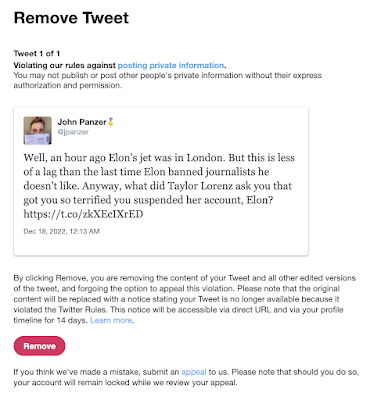
Suspended by the Baby Boss at Twitter

Well!  I'm now suspended from Twitter for stating that Elon's jet was in London recently.  (It was flying in the air to Qatar at the...