I'm about to run out the door, but just had to blog (flog?) this: Digg will support OpenID! This is obviously huge, and particularly cool for us considering the features we're about to put into production for AOL Journals tonight.
(There are so many OpenID announcements that I feel the need for shorthand. Thus, "X += OpenID", plus ! for a particularly good move.)
2007/02/20


2007/02/16
AOL and 63 Million OpenIDs (from dev.aol.com)
I'm following up on the OpenID discussion over at dev.aol.com/blog:
Tags: OpenID, identity, social software, user centric identity
Yesterday, I blogged about AOL's work-in-progress on OpenID. It generated a lot of positive commentary.I realized after reading the reactions that I buried the lead: Thereare now 63 million AOL/AIM OpenIDs. Anyone can get one by signing upfor a free AIM account. This is cool.(full article)
Tags: OpenID, identity, social software, user centric identity
2007/02/14
AOL and OpenID: Where we are
 It's not really a secret that AOL has been experimenting with OpenID. As I've said, I think that user-centric, interoperable identity is hugely important to enable the social experiences we're trying to provide. This is a work in progress, but things are coming along thanks to our authentication team's diligent effort. Here's where we are today:
- Every AOL/AIM user now has at least one OpenID URI, http://openid.aol.com/<sn>.
- This experimental OpenID 1.1 Provider service is available now and we are conducting compatibility tests.
- We're working with OpenID relying parties to resolve compatibility issues.
- Our blogging platform has enabled basic OpenID 1.1 in beta, so every beta blog URI is also a basic OpenID identifier. (No Yadis yet.)
- We don't yet accept OpenID identities within our products as a relying party, but we're actively working on it. That roll-out is likely to be gradual.
- We are tracking the OpenID 2.0 standardization effort and plan to support it after it becomes final.
2007/02/11
How many different identities can one person sanely manage?
...asks John Udell, in Critical mass and social network fatigue. I'd argue that the answer is about one and a half, in the long run. (The Shockwave Rider pushed it a lot further, but then he was founding cyberpunk. Also, he was fictional.)
When "identity" was just basically a system-local nickname used between you and a service, having multiple names for yourself was a minor inconvenience at worst, and sometimes mildly useful for privacy. Now that the services are more and more intermediaries between people, nicknames are a problem. Jon notes:
While OpenID isn't a total solution for these issues, it's a critical piece of infrastructure. As an example of the kinds of things it enables, take a look at Jyte.
When "identity" was just basically a system-local nickname used between you and a service, having multiple names for yourself was a minor inconvenience at worst, and sometimes mildly useful for privacy. Now that the services are more and more intermediaries between people, nicknames are a problem. Jon notes:
Years ago at BYTE Magazine my friend Ben Smith, who was a Unixgreybeard even then (now he’s a Unix whitebeard), made a memorablecomment that’s always stuck with me. We were in the midst of evaluatinga batch of LAN email products. “One of these days,” Ben said in, Ithink, 1991, “everyone’s going to look up from their little islands ofLAN email and see this giant mothership hovering overhead called theInternet.”Yep. Email is still the killer app of the Internet, and it wouldn't be if it were still stuck in LAN mail silos. Though spam is now so bad that I literally can't send email to a few people who can't manage their spam filters. That's a real issue and represents a real opportunity as well.
While OpenID isn't a total solution for these issues, it's a critical piece of infrastructure. As an example of the kinds of things it enables, take a look at Jyte.
2007/02/10
Jangl, community, Internets
I'm hanging out at the Community Next conference at Stanford this afternoon. A couple of quick takes:
Jangl provides control over who can call you; put a widget on your web page and people can call you but not get your real phone number. And Jangl lets you control who actually gets through. Really a feature that the cell phone companies should provide but don't -- so if Jangl is successful, will the telecoms just copy it?
Also, from skinnyCorp:
2007/02/07
OpenID + CardSpace = Ubiquity
It's great to see Bill Gates announce that CardSpace will integrate with OpenID. Convergence, and momentum, is building.
It's also great to see people like Kevin blogging about OpenID and AOL (OpenID: Should AOL Care?) (Yes.)
It's also great to see people like Kevin blogging about OpenID and AOL (OpenID: Should AOL Care?) (Yes.)
2007/02/05
The Essential Hardness of Programming
Software engineering's preoccupation is the arrangement of bits, as opposed to atoms. One of the properties of bit arrangements is that their marginalmanufacturing cost is zero; once you have an arrangement of bits, youcan make as many exact copies of that arrangement as necessary,whenever and wherever they're needed. By contrast, an arrangement ofatoms such as a bridge has a large marginal manufacturing cost, even ifyou just want an exact copy. Further, there are few physical limits tobits, while there are sharp physical limits to atoms. The only reallimit to bit arrangement is the human brain, and economics (how badlypeople want bits arranged in particular ways).
These are the fundamental reasons why nearly every software engineering project is attempting new design, and is thus hard. This is because, in the world of software, design equals bitarrangements and copying a prior bit arrangement has zero cost. Finding an appropriate bit arrangement used to have substantial cost,but that cost is falling towards zero too. So for a given project, youcan assume that competent software engineers have mostly found andcopied the relevant patterns of bits where possible, and the remainingwork is design.
Think about what the statement above means. This isn't like a civilengineer dealing with slightly differing terrain or traffic loads whenadapting an existing design for a new bridge; it's more like a civilengineer being asked to build a bridge out of Jello on Pluto. And thenext time, to build atop a moving lava flow on Mercury. In otherwords, with the easy, mechanical adaptations being taken care of bythose ubiquitous bit patterns, the problems that are left for people towork out are the hard, surprising, novel ones. Usually with nonlinearAnd in software, design really is everything; once you've taken designto a detailed enough level that the implementation is mechanical... welet the machines do it.
Which is why I winced when I read Scott Rosenberg's interview in Salon. He gets it exactly right when he notes that there's always somethingnew in every software project, otherwise there'd be no point in doingit. But he goes off the rails when he says, "...programmers areprogrammers because they like to code -- given a choicebetween learning someone else's code and just sitting down and writingtheir own, they will always do the latter." Jonathan Rentzsch hasalready skeweredthis statement better than I could. It is of course true that thereare some people who just aren't good at finding prior solutions, or atunderstanding them once found, and they may contribute to unnecessaryre-creation of software, increasing both cost and risk to largerprojects. But they're not the norm, and aren't a major cause of the"always something new" phenomenon. The essence of software developmentis new design.
This is also why attempts to map manufacturing based activities tosoftware development are at best rough approximations and at worstdangerous distractions. Software development is a knowledgeacquisition activity, not a manufacturing activity.
Subscribe to:
Posts (Atom)
Suspended by the Baby Boss at Twitter
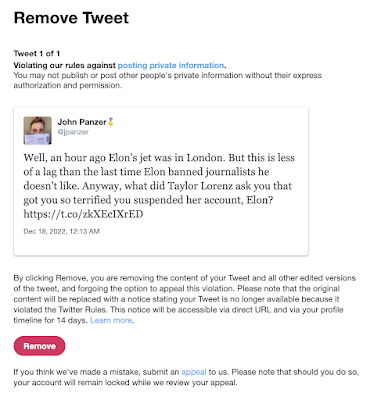
Well! I'm now suspended from Twitter for stating that Elon's jet was in London recently. (It was flying in the air to Qatar at the...
-
 Update 6/2/2023: I was right . These are my observations for our local conditions (Santa Clara County, July 10-12, 2020), which to summarize...
-
 Last night Rachel Maddow talked about an apparently fake NSA document "leaked" to her organization. There's a lot of info t...
-
Well! I'm now suspended from Twitter for stating that Elon's jet was in London recently. (It was flying in the air to Qatar at the...
